
AI delivery sprint
Production-grade AI workflows, adopted by your team, with a measured financial return.
Tested, secure and audit-ready, with adoption and financial results measured against your week-one baseline.
Companies I’ve worked with
Across product, analytics, and AI.



















Who this is for
For leaders accountable for AI that has to hold up in production and be adopted, not just launch.
CEO
- You’ve committed to AI in front of the board.
- You need AI workflows that move revenue, margin or customer satisfaction, with proof they’re adopted.
CFO or board
- You’re funding AI initiatives, or already paid for an attempt that stalled.
- You need each next spend to produce a number you can check.
COO or head of transformation
- You own process stability: AI that fails safely, and a rollout that sticks.
- You want a plan for both, not hope.
CPO or head of product
- You need AI workflows that fit your roadmap, data and stack, and build on what your team already owns.
- Your team owns the result afterwards, with support if you want.
Why it matters
Many AI projects stall before production, and many more reach production and are never adopted.
11%
of organisations are actively using agentic AI in production. Another 38% are still piloting.
Source: Deloitte, Tech Trends 2026.
42%
of organisations abandoned most of their AI initiatives before production, up from 17% a year earlier.
Source: S&P Global Market Intelligence, 2025, 1,006 respondents.
97%
of executives say they deployed AI agents in the past year. 52% of employees use them.
Source: WRITER, 2026 enterprise AI survey, 2,400 respondents.
83%
of CEOs say AI success depends more on people’s adoption than on the technology.
Source: IBM Institute for Business Value, CEO Study 2026, 2,000 CEOs.
A pilot proves an idea works once, on test data. Production means it keeps working on real data, every day. Adoption means your team still relies on it a month later. This sprint is judged on all three, with evidence at each step. For AI placed on the market or put into service from 9 December 2026, the EU’s revised Product Liability Directive treats software as a product, so that evidence matters more.
Where are you starting?
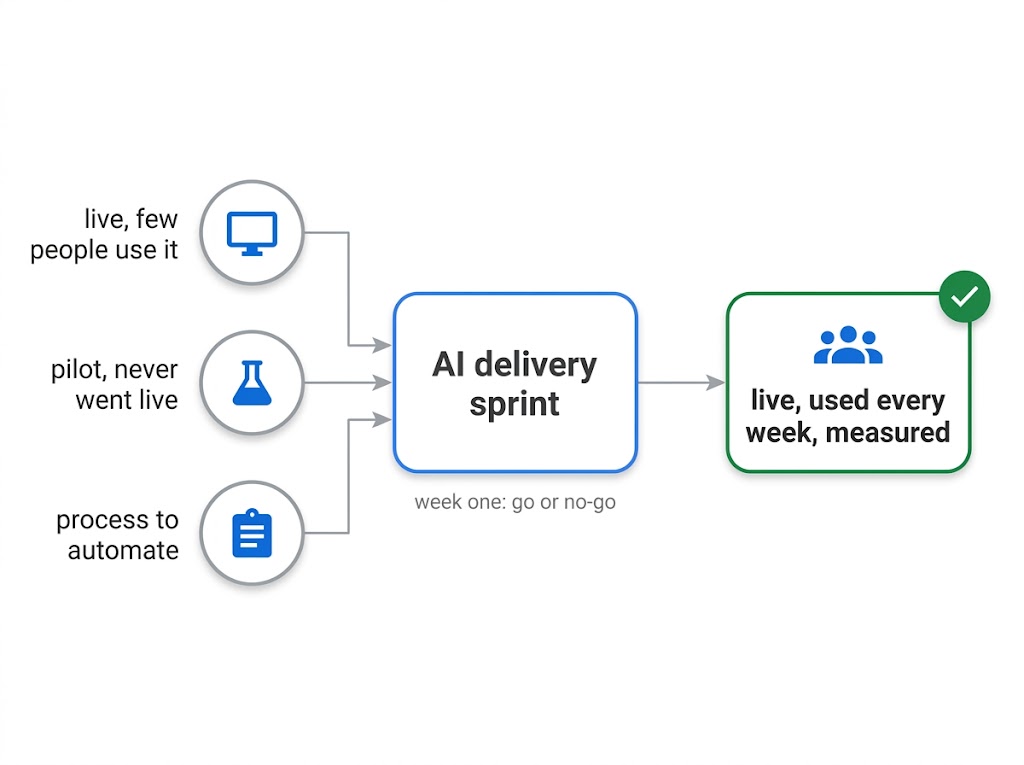
Three starting points, one finish line: production-grade, adopted, measured.
Live, but few people use it
• You have: an AI workflow, bought or built, that few people use
• I diagnose the stall, fix the cause (training, process or set-up), and relaunch
A pilot that never went live
• You have: a pilot, a vendor demo, or a shelved attempt
• I finish or rebuild it, prove it on your past cases, take it to production and drive adoption
A process to automate
• You have: a process your team does by hand, and no AI working on it yet
• I design and build the AI workflow, prove it on your past cases, and take it to production with your team
Weighing several AI ideas, or not sure where to start? The AI value review picks the one to do first.
What you get
AI workflows in production, adopted by your team and measured, not another demo.
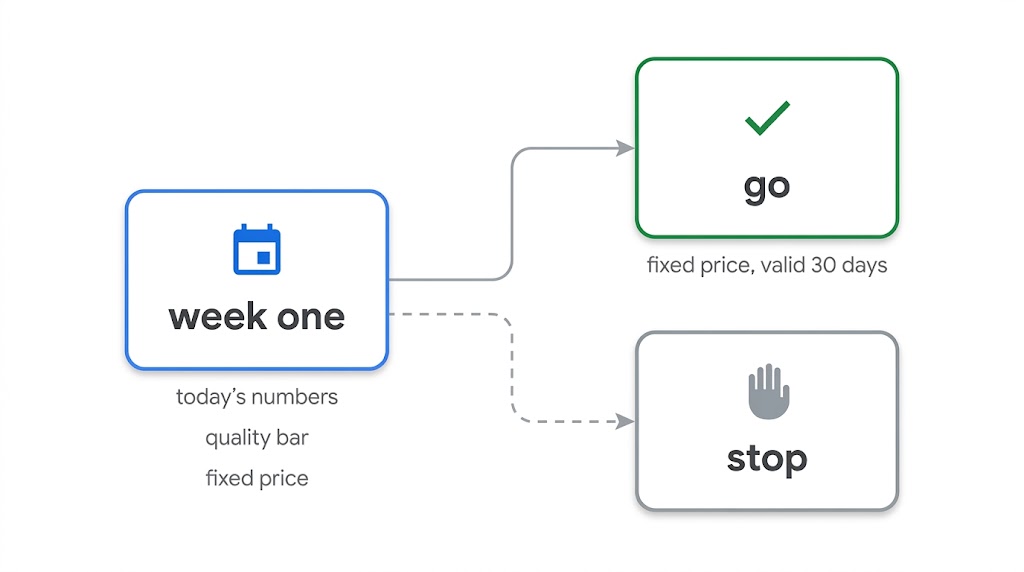
Week one: a go or no-go before anything gets built.
- Does something you already pay for, or a simple template, already do the job?
- You get a written go or no-go, today’s numbers, and the quality bar.
- If it’s a go, you get a one-page scope sheet and your fixed price, valid for 30 days.
A production-grade AI workflow, not a demo.
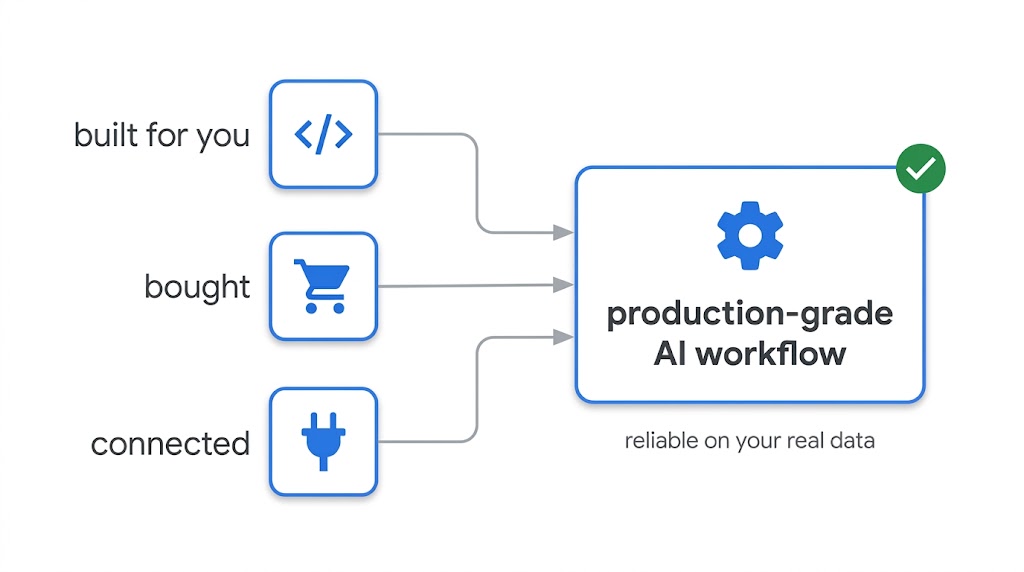
- Production-grade: reliable enough for daily work on your real data.
- Built for you, bought, or connected to what you have, whichever fits.
- Finished from your existing pilot, or set up from scratch.
Checked against your past cases, not guesswork.
The AI workflow’s answers are tested on your past cases, then again on cases it has never seen.
Every step logged from day one.
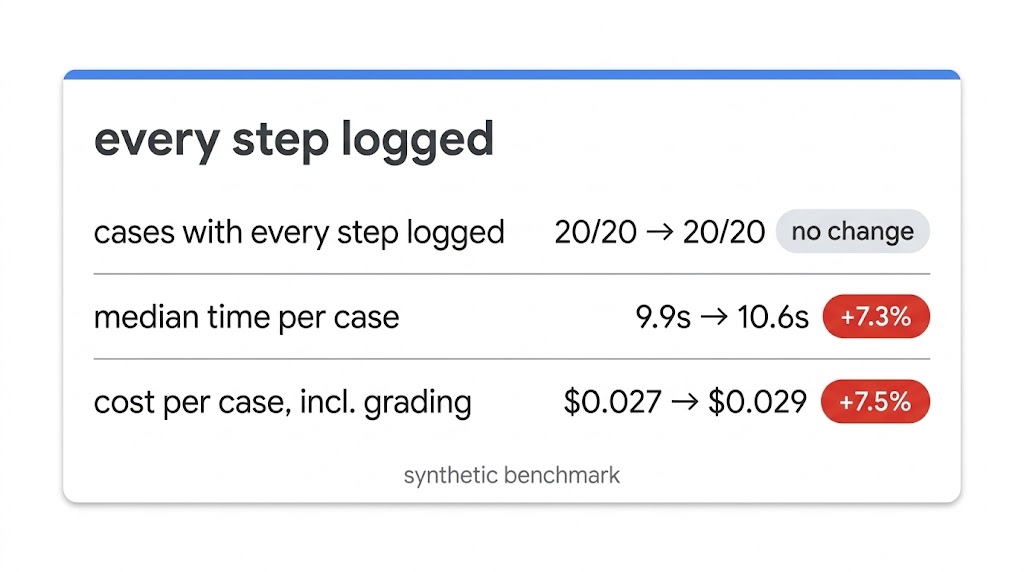
- Every AI step is logged, with cost per case and quality checks visible from launch.
Adoption designed for the people who do the work, not the people who approved the budget.
- Real sessions on real work, not a slide deck.
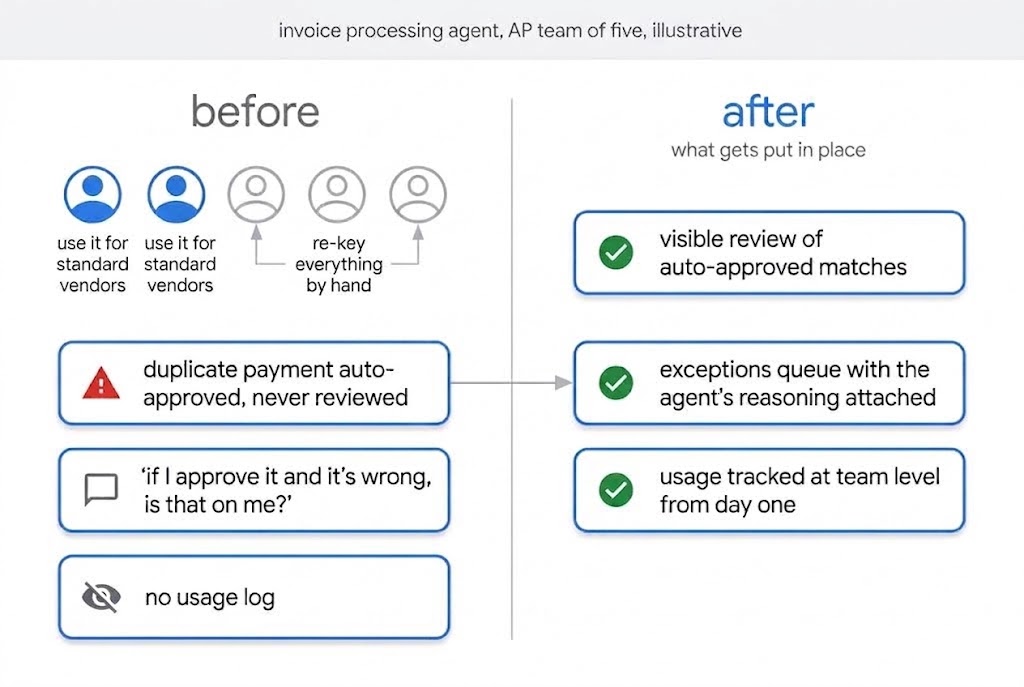
- An honest answer to “if I approve what the AI flagged and it’s wrong, is that on me?”
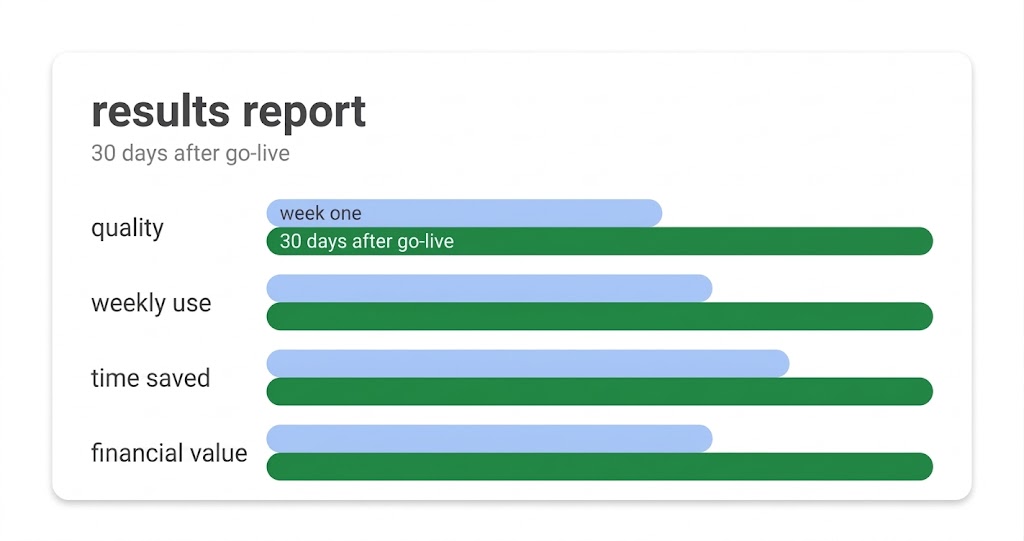
Adoption and financial value measured, not assumed.
- Usage tracked per team from rollout, not per person.
- 30 days after go-live: a results report against week one’s numbers.
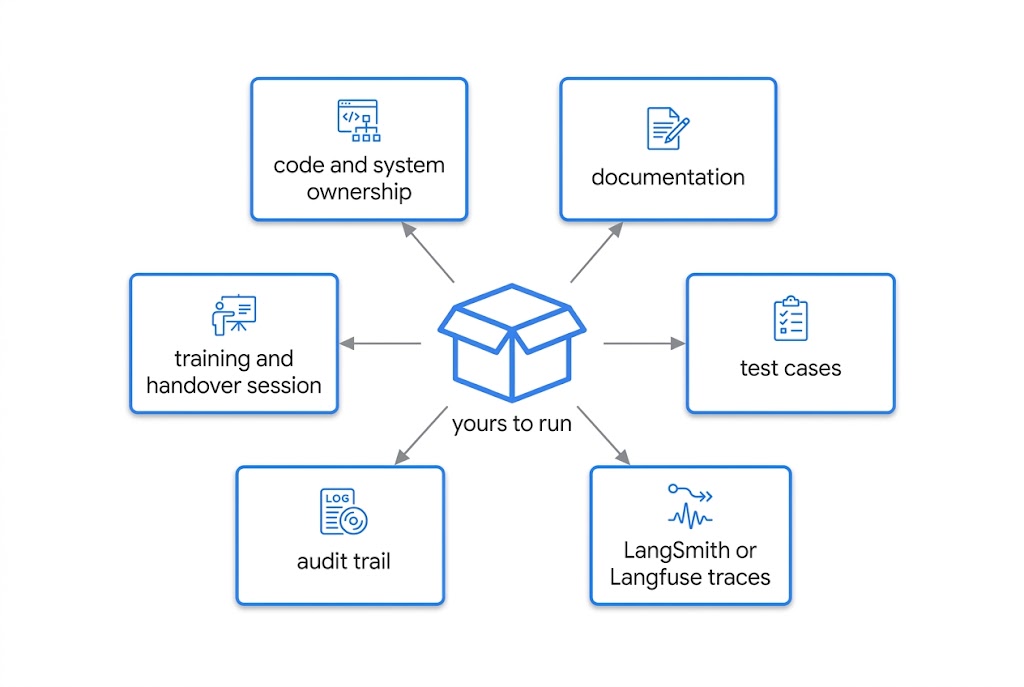
A handover, not a dependency.
- Code, test cases and dashboards are yours once paid, in your accounts.
- Your owner runs a live case with me before I hand over.
Why it works
Most AI work is judged on whether it shipped, but this sprint is judged on four links of evidence: quality, use, process and money.
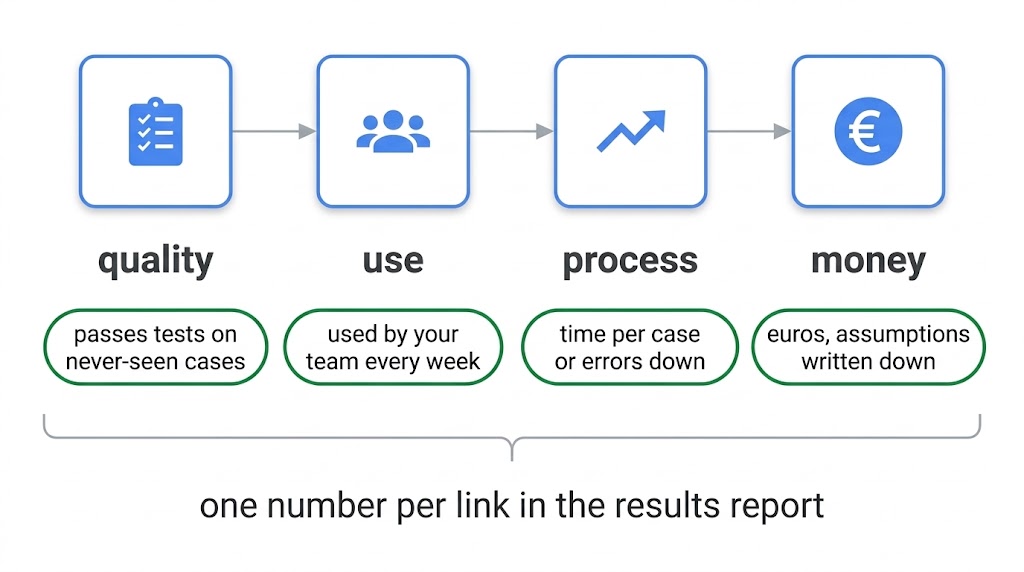
The results report gives one number per link, against week one’s numbers, with the assumptions behind the financial value written down.
What “production-grade” means
Six guarantees that make AI workflows safe to run every day, each backed by a specific check.
Data kept separate
- Each team’s or client’s data stays walled off from the others.
- Isolation is tested before a second team or client is added.
Every step logged
- Any decision can be explained and rebuilt from the logs: your audit trail.
- Every AI step, tool call and hand-off is recorded in your own Langfuse or LangSmith account (tools that log each step).
Every change retested
- Quality doesn’t slip when something changes: every change is retested on your past cases.
- A final test on cases kept aside produces an acceptance report against the quality bar.
Safe fallbacks
- When the AI is unsure, a named person takes over, and nothing fails silently.
- Every failure point has a tested fallback: escalate, hold or ask for more information.
Security, privacy and compliance
- Built to stand up to your IT and compliance review: least-privilege access, a data map, a GDPR data processing agreement.
- Tested against the OWASP top 10 for LLM applications and, for agents, its agentic top 10. OWASP is the open application-security community.
- A compliance note mapped to AIUC-1, the standard for AI agent security, safety and reliability, plus a general EU AI Act and product liability check.
Cost control
- No surprise bills: cost per case is tracked and visible, not found at month-end.
- A spend cap, tested with a forced retry loop.
How it works
A sprint is a fixed-length, time-boxed piece of work with a measured result, as in agile.
1. Scope (week one)
- Check: does something you already pay for handle this? Does it need AI?
- You get: a go or no-go, today’s numbers, the quality bar, your fixed price
2. Build, test and ship
- Set up, finish or fix the AI workflow, against the six checks above
- Tune it against your main business metric, like time per invoice
3. Adopt
- Roll out with the people who do the work, team by team
- If usage stalls: find why (wrong process, no training, a bad early experience, the AI workflow itself), fix that cause
4. Prove and hand over
30 days after go-live: a results report against your week-one baseline. Then your team runs it, with an optional support plan, and the method repeats on your next process.
Example: When adoption stalled
An illustrative example, not a client: what stalled adoption looks like in invoice processing, and the fix.
An invoice-processing agent, live eight months, never trusted.
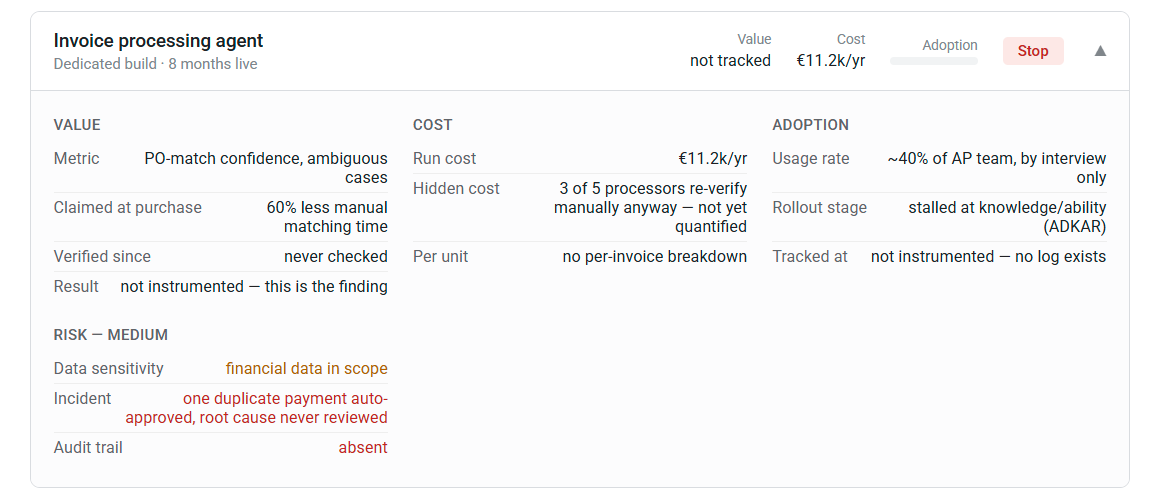
One duplicate payment was auto-approved early on and never reviewed. The team quietly went back to checking everything by hand.
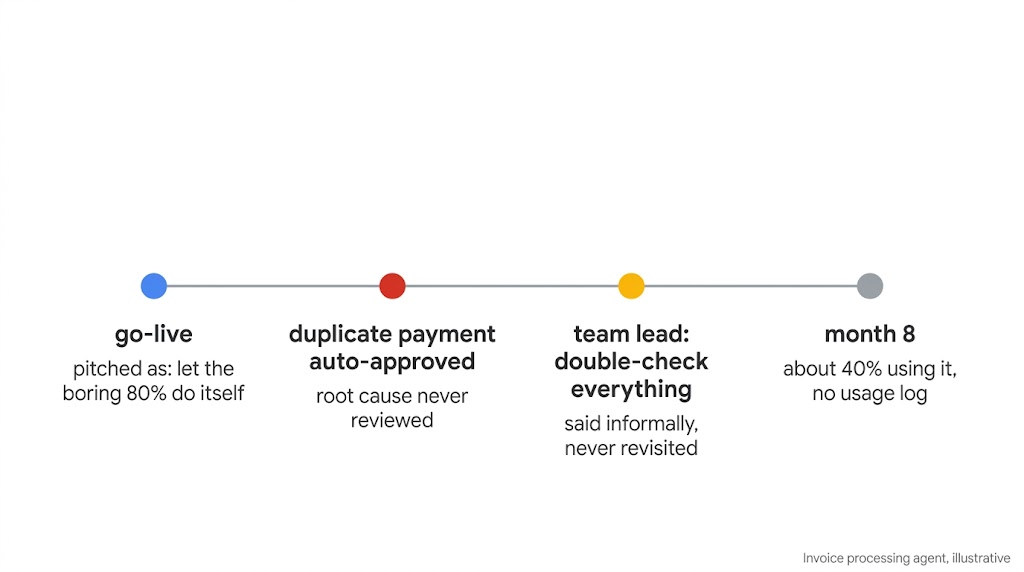
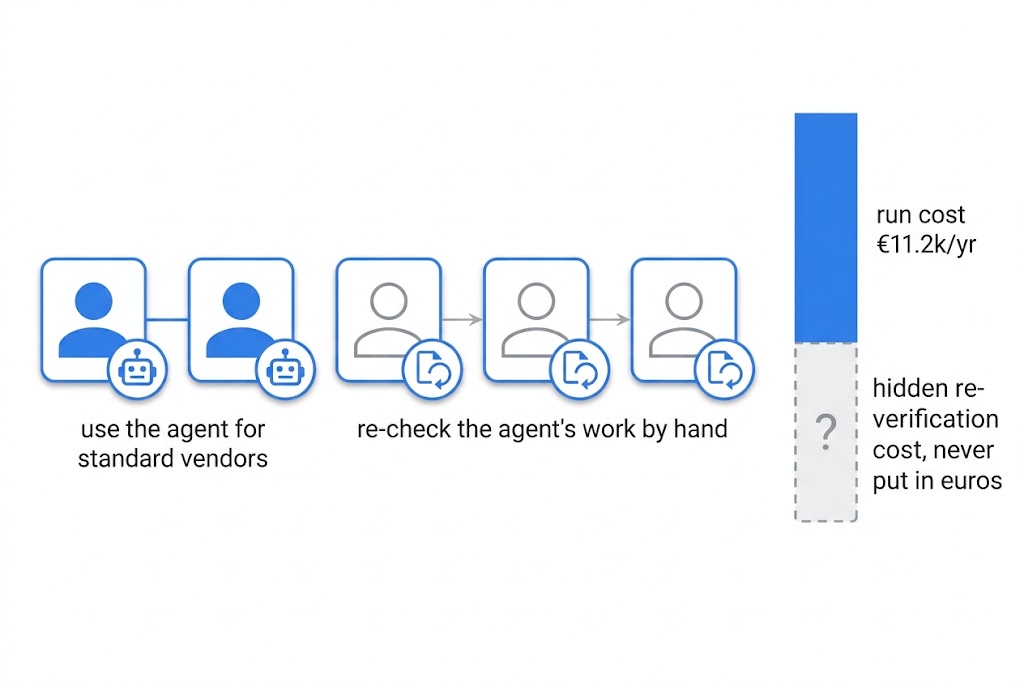
The agent cost €11.2k a year to run. Three of five processors re-checked its work anyway, a cost nobody had counted.
People knew the agent and wanted it to work. What never followed launch was know-how, practice and follow-up. Here the fix is a visible review step and a reason to trust the exceptions queue again.
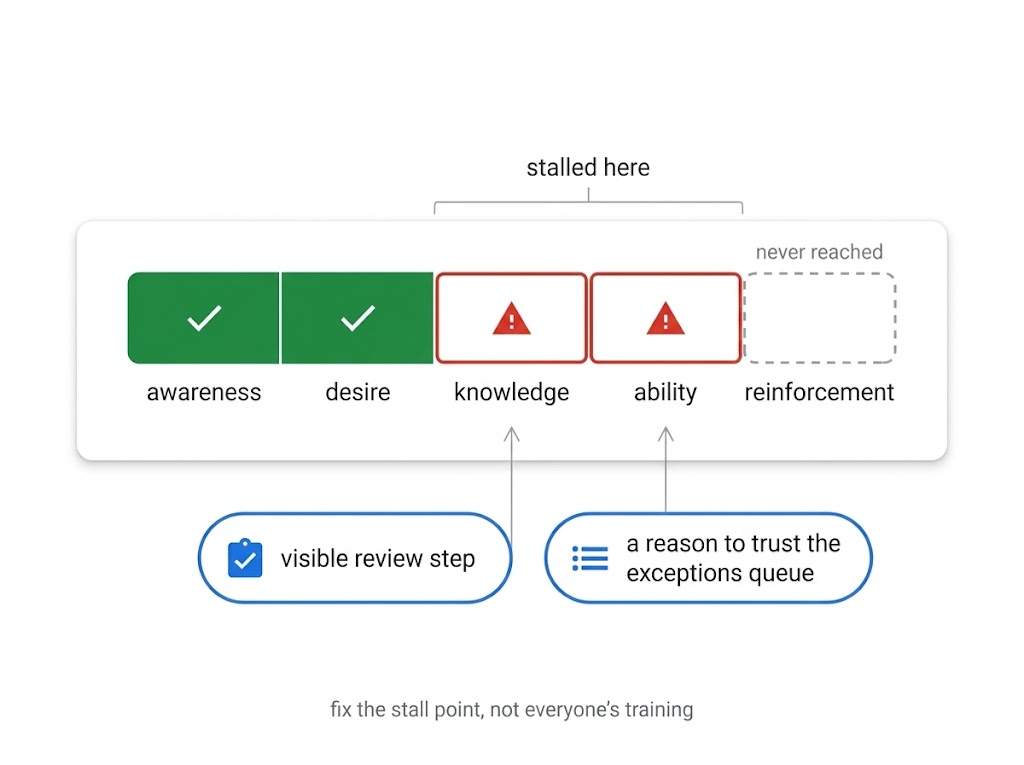
Each team’s rollout stage is tracked, so the next stall shows in weeks, not eight months.
Example 2: Tested and proven AI system
A multi-agent healthcare coverage-approval workflow, modelled on real work and run here on synthetic cases.
Four AI agents route the case, gather evidence, prepare a payer package and hand a clear action to a named person. Safety gates a person controls sit around every step, and nothing leaves the test environment without sign-off.
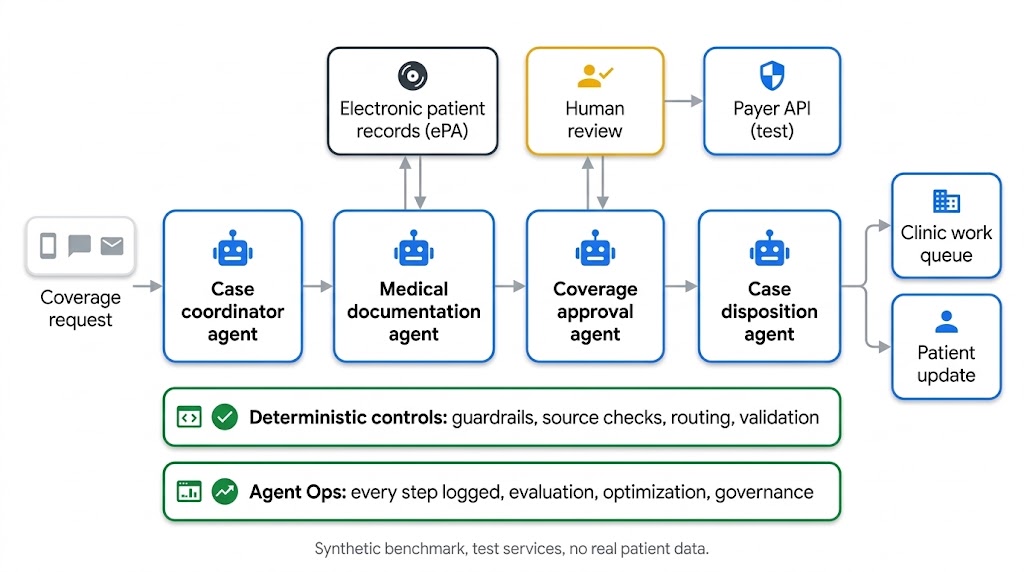
Time, cost per case and logging coverage are tracked at every step.
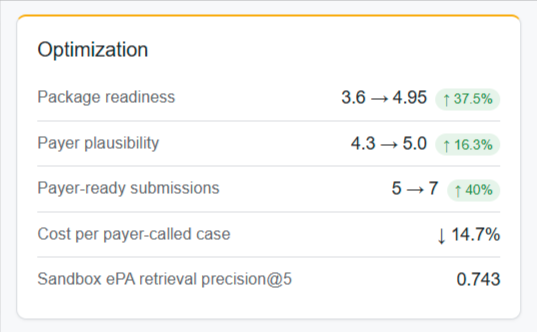
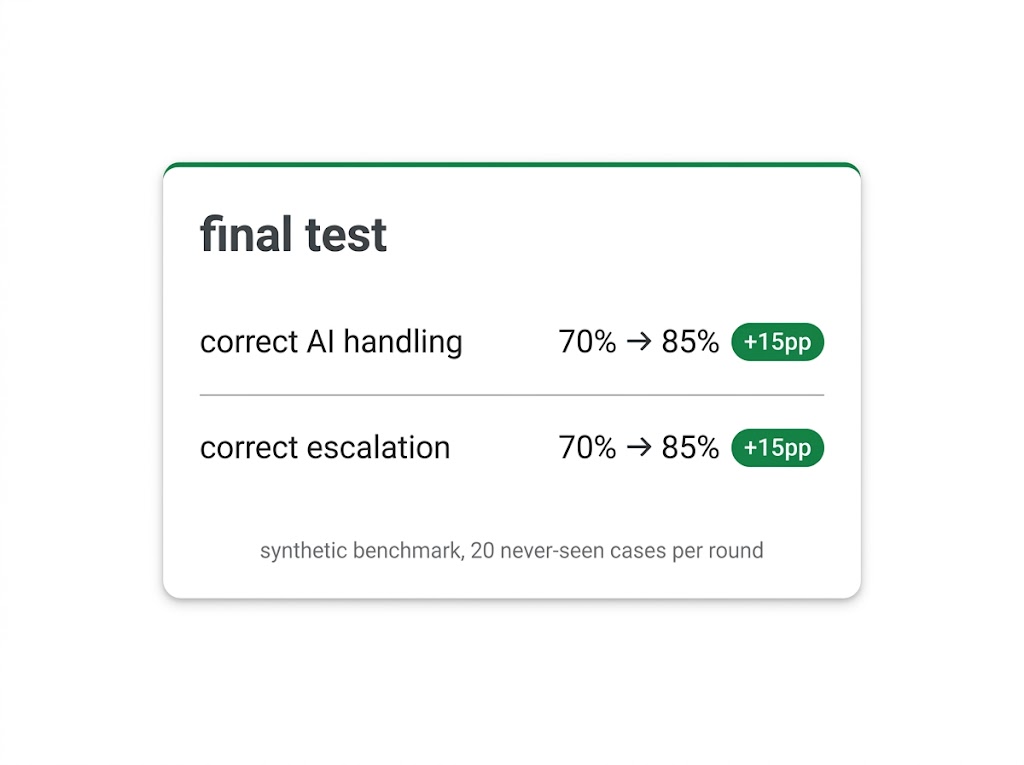
The first full test found real gaps: 70% correct handling. Correct handling includes the AI passing a case to a person when it should.
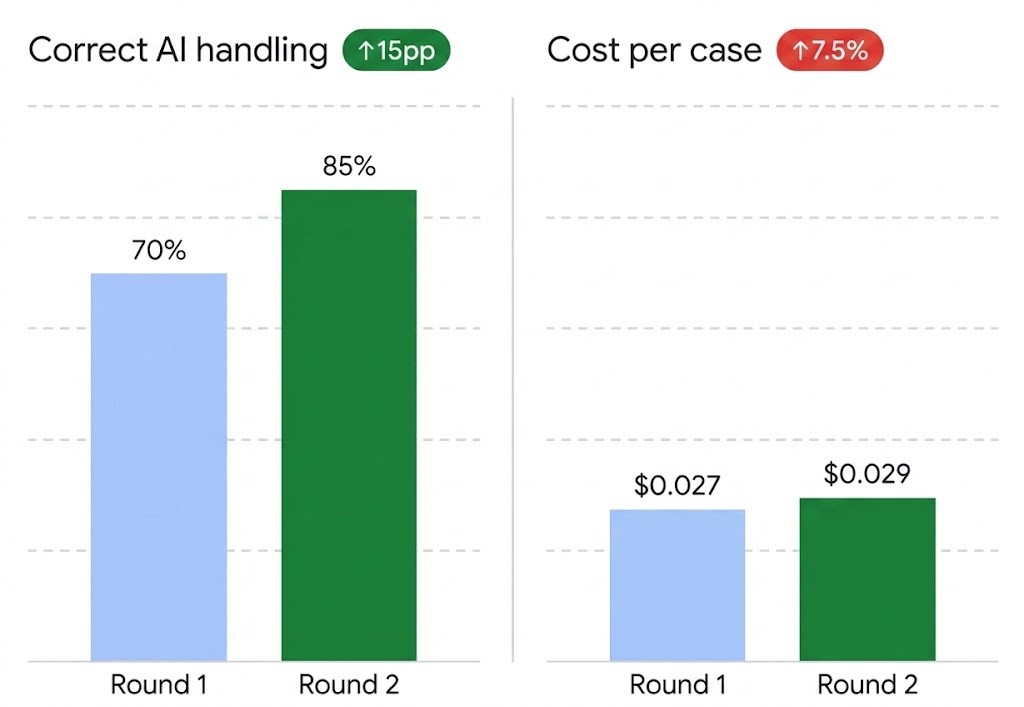
Three routing and evidence bugs were fixed, then retested on new, never-seen cases. Correct handling rose from 70% to 85%, with zero unsafe actions in both rounds. Cost per case, including automatically grading each test, rose from $0.027 to $0.029.
Pricing
Week one decides whether to go ahead; delivery and proof follow once your price is fixed in writing.
Week one: decide
A go or no-go, ending in your fixed price
- Does something you already pay for, or a simple template, do the job?
- You get today’s numbers, the quality bar and a signed scope sheet
- A fixed-fee first step: stop here if the work isn’t worth doing
Build, test and go to production
Live about 4 to 7 weeks after you sign
- The AI workflow set up, finished or fixed to your scope sheet
- Every change retested, then a final test on cases kept aside
- Security, privacy and logging checks before production
Adopt, prove and hand over
Results report 30 days after go-live
- Rollout sessions with the people who do the work
- Adoption tracked per team, with stalls found and fixed
- Code, test cases and dashboards are yours once paid
Bigger or more complex, any starting point
Week one first, then a fixed quote
• Three or more systems, several AI agents with tested hand-offs, or more teams
• Regulated-sector data, such as health or insurance records
• Same testing, security checks, rollout and handover as every sprint
Your fixed price depends on your starting point and scope. You see it in writing at the end of week one. Not included: model, hosting and licence costs, paid to your providers. If the quality bar is missed, fixes for up to two more weeks cost nothing. Reference-client terms are available for suitable projects. Ask on the call.
Who I work with
Ravi leads each engagement, supported by senior advisors and experienced specialists selected for the workflow.

Ravi Ayyala
Founder and product AI lead
- I lead each engagement, supported by senior advisors ad experienced specialists selected for the AI implementation.
- Ex-LinkedIn, ex-Blacklane (Uber) product leader.
- MBA (Oxford), AI trained (Stanford), Engineering (NUS)

Linde Scheers
Marketing and growth advisor
- Advises SmartProduct and selected client work on positioning, adoption and distribution.
- Former Google leader and former CMO at eBay Germany.
- Currently CMO at ING Germany.

Shankar AVSB
Finance and strategy advisor
- Advises SmartProduct and selected client work on investment thinking, business outcomes, and technology.
- Technology investor with experience at ABB and Infosys and study at Stanford.

FAQ
Everything else worth knowing before you book a call.
Get AI workflows into production, adopted by your team and measured.
A free 30-minute call, no slides. It ends with a yes or no on week one.