
AI value review
Know which of your AI workflows pay back, and which to fix, stop or start next.
I score each AI workflow in production on value, cost, adoption and risk, and rank planned ones by payoff, effort and data.
Companies I’ve worked with
Across product, analytics, and AI.


















Who this is for
For leaders accountable for what their AI workflows return (business processes where AI does part of the work and your people check the results).
CEO
• The board will ask what your AI portfolio returns.
• You need the answer in revenue, margin and customer satisfaction, including what to stop funding.
CFO or board
• You approved AI budgets across several teams.
• You need a number per workflow that you can check line by line.
COO or head of transformation
• You run the rollouts across teams.
• You need to know which processes are adopted, and which teams quietly work around them.
CPO or head of product
• Not all of the AI in the company came through your roadmap.
• You need to know which overlap with what you already pay for, and what to keep, fix or stop.
Why it matters
AI spending is rising fast, and most companies still can’t tie it to earnings.
$2.52T
Worldwide AI spending forecast for 2026, up 44% year over year.
Source: Gartner, January 2026.
37%
of organisations can attribute any EBIT impact to AI, unchanged from last year.
Source: McKinsey, The state of AI in 2026, 1,719 respondents.
6%
attribute 5% or more of their EBIT to AI.
Source: McKinsey, The state of AI in 2026, 1,719 respondents.
25%
of AI initiatives have delivered the ROI expected of them. Only 16% have scaled enterprise-wide.
Source: IBM Institute for Business Value, CEO Study 2025, 2,000 CEOs.
Without a baseline, there’s nothing to compare a result against. Without an agreed definition of “working”, every claim is an opinion. Without adoption tracking, a stalled rollout stays hidden for months. For AI placed on the market or put into service from 9 December 2026, the EU’s revised Product Liability Directive treats software as a product, so missing evidence becomes a liability question too.
What you get
A decision for each AI workflow, backed by evidence, not a strategy deck.
A scored view of every workflow, with a call for each.
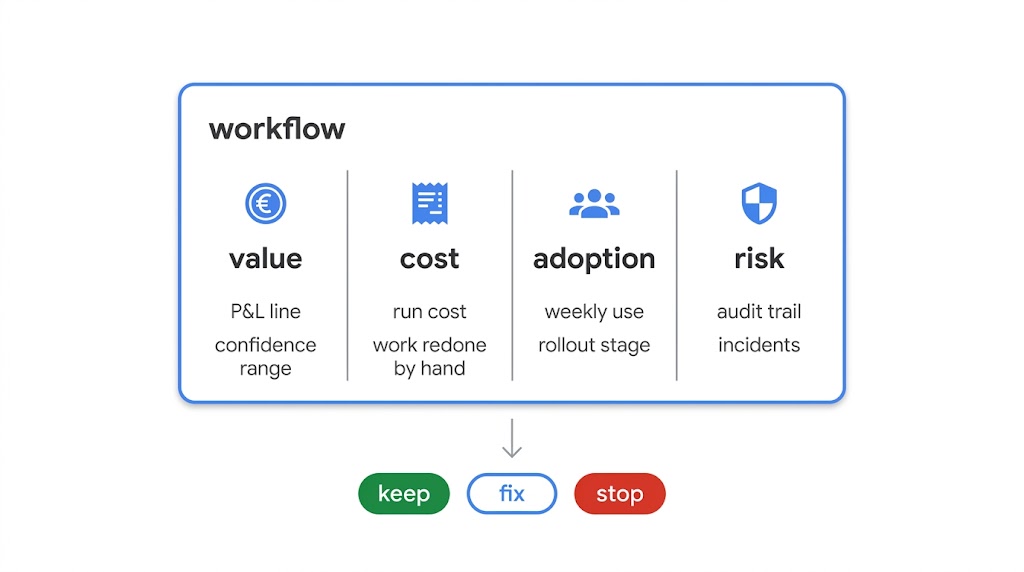
• Value, cost, adoption and risk, in your own numbers.
• Cost counts run cost, cost per case, and people redoing the AI’s work.
• Keep, fix or stop, with the stop criteria written down.
An honest measurement-gap map.
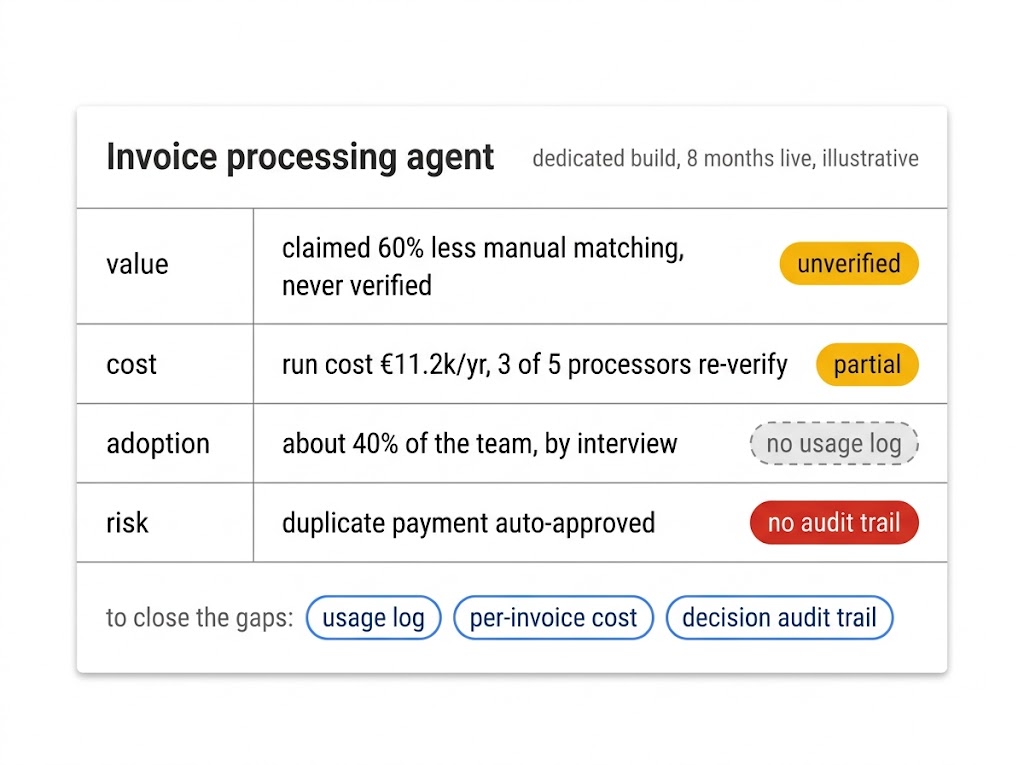
- What can’t be measured yet, such as missing usage logs or audit trails, and what it takes to close each gap.
A scoped next step, only where one pays back.
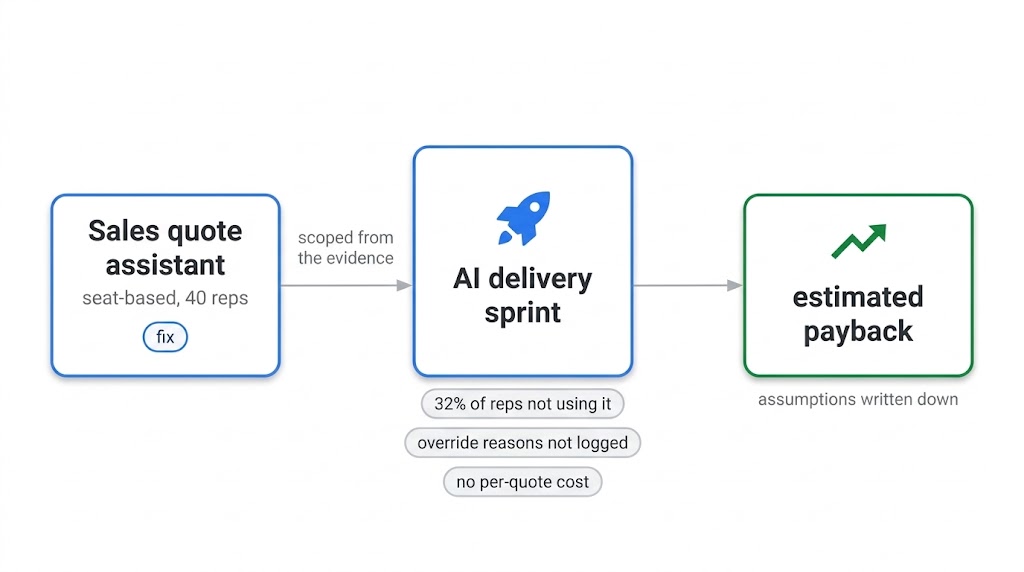
• For each workflow worth fixing or starting: what an AI delivery sprint would change, its estimated payback and assumptions.
• The sprint’s first week fixes its price in writing.
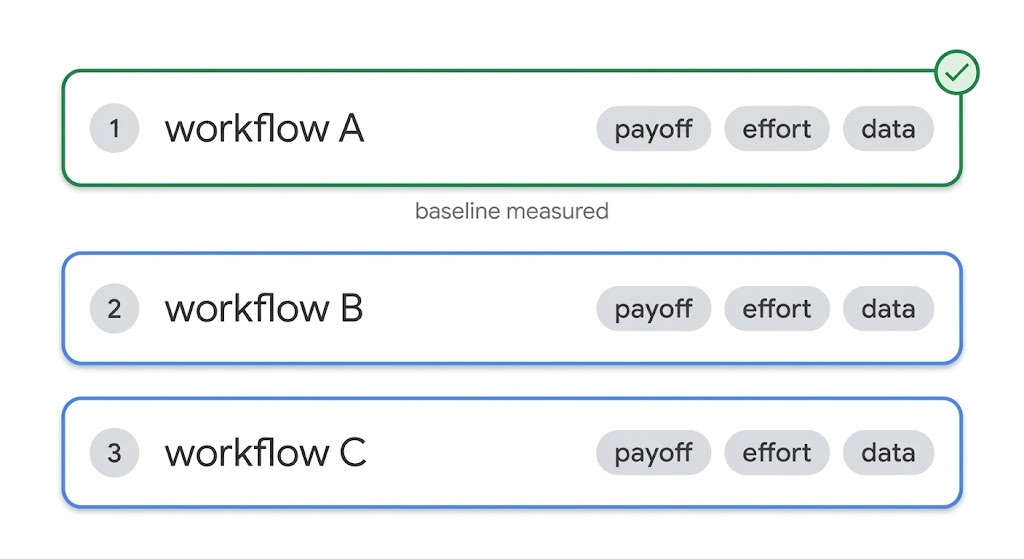
Nothing in production yet? A ranked shortlist.
- The 2 or 3 processes most worth starting, ranked by payoff, effort and data readiness.
- A baseline for the top one. Part of the portfolio review.
How it works
Four steps, from your list of AI workflows to a decision for each.
1. Define “working”
A short session per workflow ties “is it working” to one number that drives a P&L line, like quote-to-close rate.
2. Score against evidence
• Evidence comes from billing exports, usage logs and short interviews.
• Where evidence is missing, the gap is a finding.
3. Make the call
Keep, fix or stop for each workflow, with what I found and where the evidence runs out.
4. Scope the next step
Where a fix or a new workflow pays back, you get the sprint scope and estimated payback.
Why it works
Each value figure is traced to numbers your CFO can check, and compared with teams that don’t have the AI workflow yet.
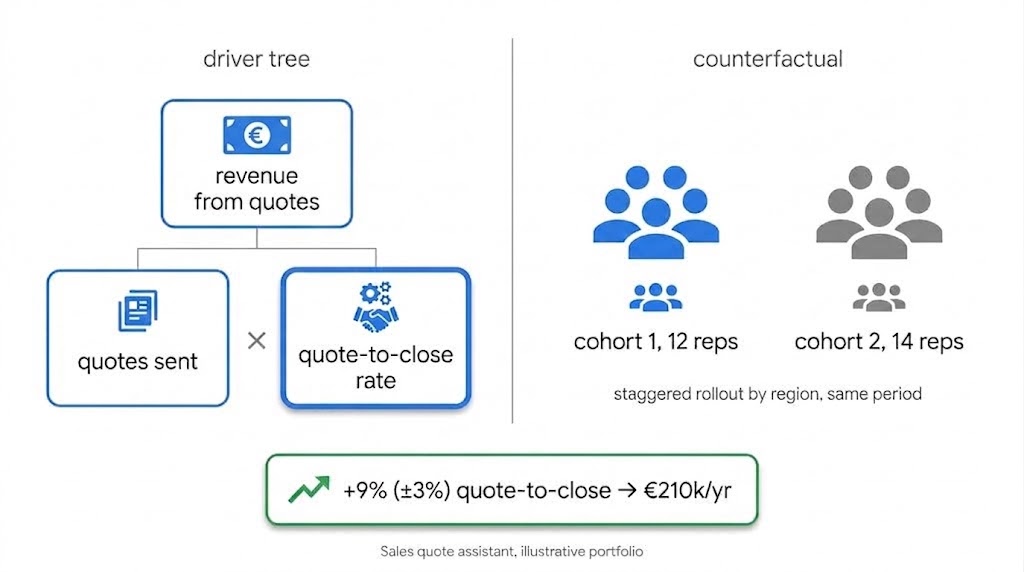
A driver tree breaks a claim like “this saved money” into the numbers that add up to it. A counterfactual compares teams with and without the AI workflow over the same period, so the result comes with a confidence range, like ±3%.
Example: AI agent portfolio walkthrough
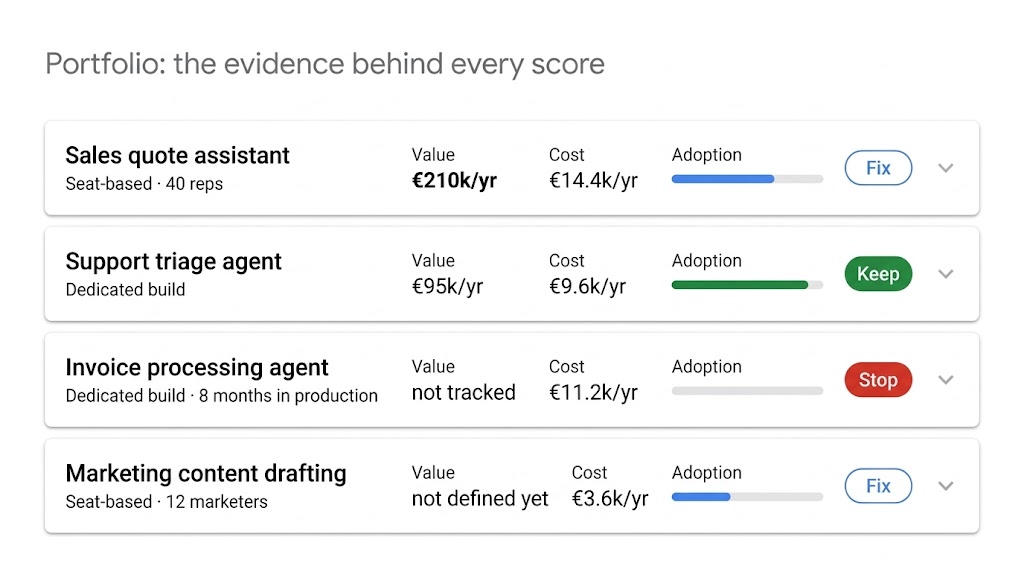
An illustrative portfolio of four AI workflows, not a client, scored the way the review works.
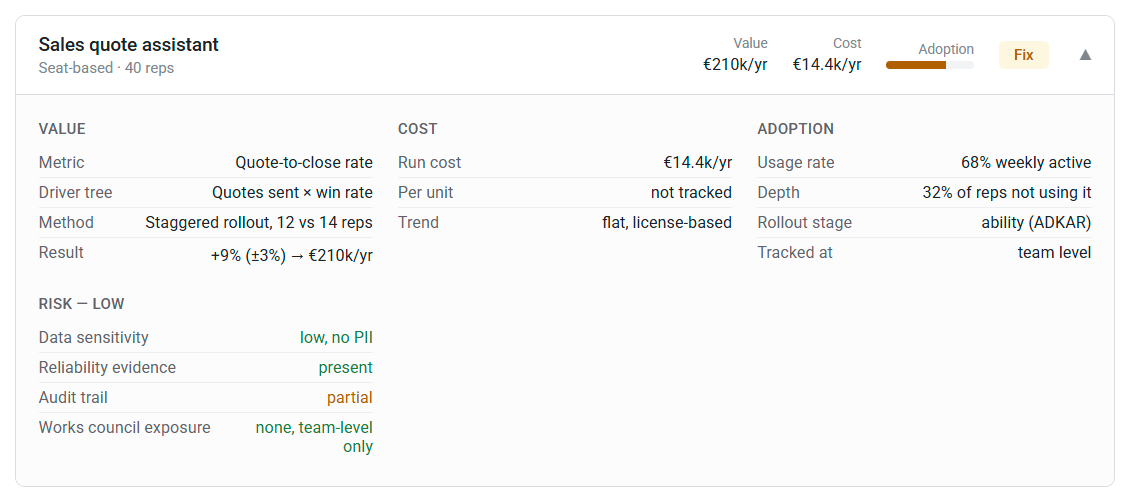
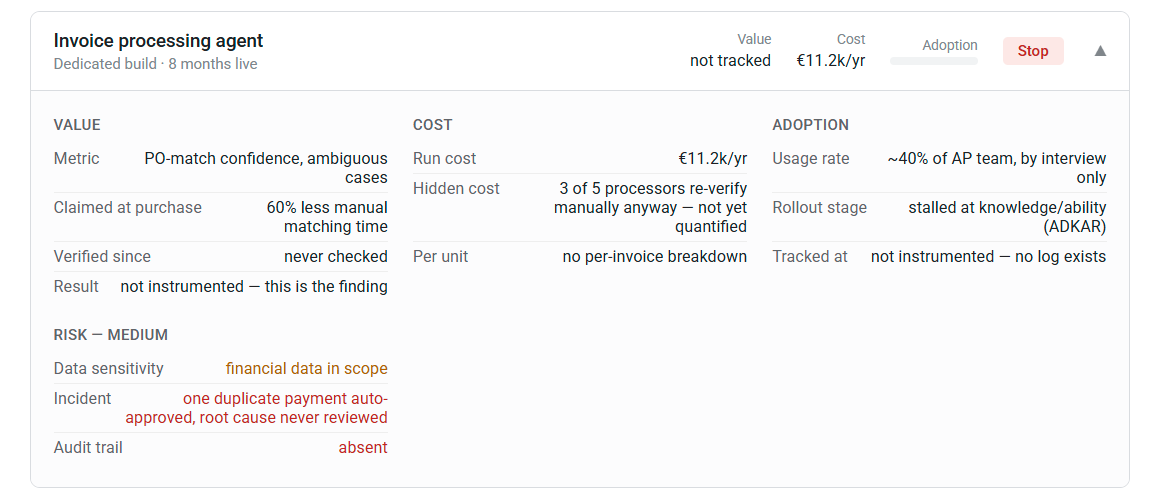
A sales quote assistant, a support triage agent, an invoice processing agent and marketing drafting, each scored on the same four columns.
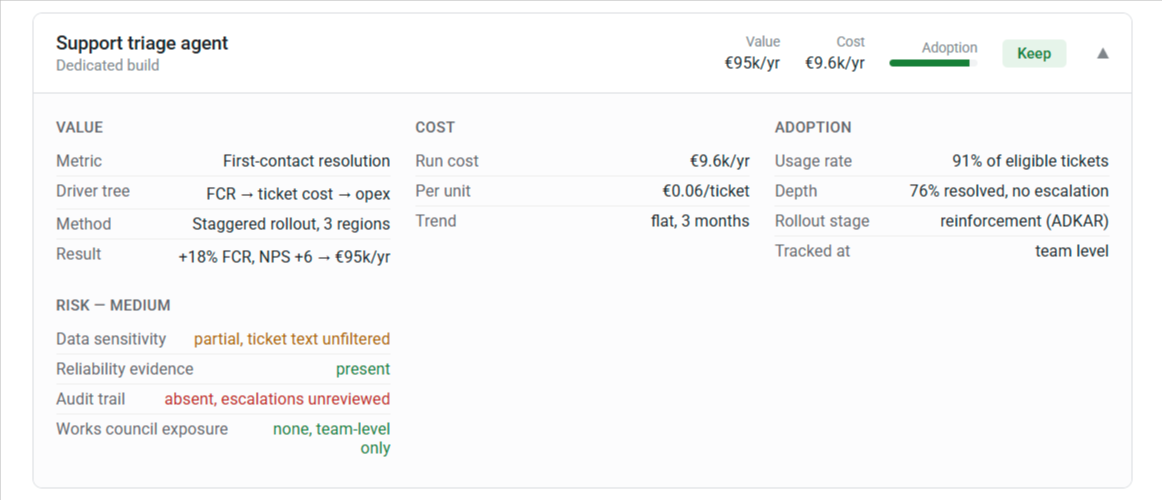
Support triage lifted first-contact resolution 18%, worth €95k a year against €9.6k run cost. The missing audit trail is still flagged.
Quote-to-close rose 9% (±3%), but 32% of reps don’t use the assistant. The rollout stalled at ability, on ADKAR: how far each team has got, from knowing the AI workflow to using it by habit.
The invoice agent’s claimed 60% time saving was never checked in eight months in production. Three of five processors re-check its work by hand, and a duplicate payment went through unreviewed.
Pricing
Prices are “from”: your fee is fixed in writing before I start, set by the workflows and systems in scope.
Single workflow
From €2,900
- One AI workflow in production
- Value, cost, adoption and risk, scored in your numbers
- A keep, fix or stop call, with the evidence behind it
- A list of measurement gaps and how to close them
- 1 to 2 weeks
Portfolio
From €5,900
- Up to five workflows, or one that spans two or more systems
- Every workflow scored on the same four columns, with a call for each
- Nothing in production yet? The 2 or 3 processes most worth starting, ranked
- A board memo and a roadmap for closing the measurement gaps
- 3 to 4 weeks
Larger portfolios
A fixed quote after the call
- More than five workflows, or several business units
- The same scoring, calls and board memo as the portfolio review
- Want someone to own the portfolio afterwards? See the fractional AI lead
Systems are the software a workflow connects to, like your CRM or ERP. Prices exclude VAT. The review fee counts in full toward a sprint booked within 60 days. Know which workflow needs work? Start with the AI delivery sprint.
Who I work with
I’m Ravi, and I lead every review, with senior advisors and specialists chosen for your processes.

Ravi Ayyala
Founder and product AI lead
- Leads the review, translates from business to AI, the build if it makes sense, and user adoption.
- Ex-LinkedIn, ex-Blacklane (Uber) product leader.
- MBA (Oxford), AI trained (Stanford), Engineering (NUS)

Linde Scheers
Marketing and growth advisor
- Advises SmartProduct and selected client work on positioning, adoption and distribution.
- Former Google leader and former CMO at eBay Germany.
- Currently CMO at ING Germany.

Shankar AVSB
Finance and strategy advisor
- Advises SmartProduct and selected client work on investment thinking, business outcomes, and technology.
- Technology investor with experience at ABB and Infosys and study at Stanford.

FAQ
Everything else worth knowing before you book a call.
Find out which AI workflows pay back, and what to fund next.
A free 30-minute call, no slides. It ends with a yes or no on the review.